Another excellent case study on how cultural attitudes and values (economic versus environmental especially) lead to conflict in one of the world's most charged regions. This case study is an excellent example of the environment as a contested category and how different cultures view the vital resource of water - economic development & geopolitics versus indigenous cultural rights versus environmental value (biodiversity). The map link here shows a classic case of upstream versus downstream conflict & dispute (http://mapsof.net/map/jordan-river-map).
Opinion: Cultural cooperation is key to this area in order to preserve the cultural heritage from a multi-faith perspective!
Other opinions suggest that Israel is violating the human rights of indigenous Palestinians by not only occupying territory but also denying water access to the Palestinians - however, this is the opinion of Amnesty and it is a very divisive & debated issue!
Arguably in a post-industrial society we have moved towards 'valuing' the environment very differently to how we used to perceive it; an economic resource to be exploited under the guise of such paradigms like industrialisation, modernisation or globalisation. According to Kuznets would the West place itself in an era of increasing environmental awareness and decreasing degradation?
Since Carson's Silent Spring and the emergence of radical environmentalism in the 1970s &1980s, the environment has become an issue of common parlance and to put it simply, the environment matters. Today the environment should be (and to some extent is) viewed as as a holistic concept (economic, biodiversity, social-cultural etc etc) as UNESCO outlines in it's definition & mission statement. Clearly though, the latter developments have meant that from an economic perspective whilst economists still see value in the environment, it is fundamentally a different type of value to the one in the industrial period (http://www.bbc.co.uk/news/science-environment-17448634).
The new paradigm of the environmental movement of the 1990s and new millennium was Sustainable Development, and as the environment became an issue of national (and international) security, politicians and academics started to see the need not only to protect but also to preserve the more subtle cultural and often spiritual connections organisms had to the environment. It appeared that the cries of deep ecologists to revert back to pre-industrial times had been answered (well not really!) - alas though, the the environment is and always has been/will be a contested category providing that the human population conitue4s to grow and expand and nations continue to industrialise. Thus, with the Advent of the new Rio Summit there are cries (as there were in 1992) to improve our level of protection and romantic platitudes of a return to some modified form of a pristine wilderness...!(Just look at the BBCs recent programming over the past 5 years to increase our environmental awareness).
I would argue though that on the hand yes, protection is paramount, but from my time researching in Honduras, i would caution outright protection as often the Western model of a core and buffer zone can alienate the local people from the land and cut the connections which make that particular environment so diverse - just look at Ayres Rock (or Uluru) to see how poor management can lead to severe conflict...Israel, Palestine and the West Bank water security issues is another example.
Q: To what extent do different cultural attitudes to the environment make conflict inevitable?
Discussion: Is there such a thing as a pristine wilderness as Humboldt asserted or not? Discuss.
Fred Pearce's article provides an excellent service in highlighting the chronic problems around the world of excessive groundwater exploitation - but it may not be taking us much further forward in finding solutions...what's your opinion?
Check out this month's New Scientist - Whose water is it? Very good for water security and conflicts.
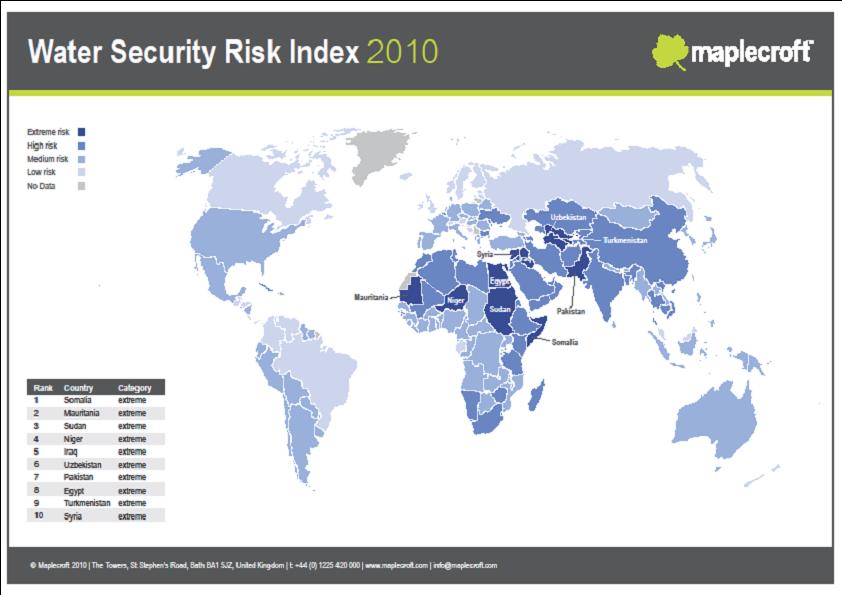
A great piece on water (in)security in Egypt from the Guardian - excellent for U6th students and environmental geographers:
Egypt is almost entirely dependent on the River Nile, which provides around 95% of its drinking and irrigation water. Protecting this supply has long been regarded as a matter of national security but the new political situation inside Egypt raises questions about its future.
First, the instability of the revolution has arguably diminished Egypt's regional presence and diplomatic strength in the basin. Incorporated in the Mubarak regime was a regional dominance, with significant support from the United States. This gave Egypt both a diplomatic and military advantage, which appeared insurmountable to the less powerful upstream states. For example, Egypt had consistently put pressure on the Arab League not to supply loans to Ethiopia for Nile water development.
With Mubarak's overthrow, a new optimism surfaced in the upstream countries. This is symbolised by Ethiopian prime minister Meles Zenawi's announcement of the Grand Ethiopian Renaissance dam at the end of March – just one month after Mubarak was ousted from power. The proposed dam, the largest in Africa, is forecast to generate 5250 megawatts of hydroelectric power, and has significant implications for Ethiopia and neighbouring countries that may also benefit from the energy produced.
Second, the newly independent South Sudan now has voting power as the 10th riparian state in the basin. With its own energy, infrastructure and resource needs, South Sudan is a relative unknown in its position on the Nile water agreements. However, its plan to build a dam in Wau, on a tributary to the White Nile, highlights its own independent needs, and is a further factor for Egypt to consider.
Finally, the increasing demand for agricultural land across eastern Africa, often described as "land grabbing", has significant implications for water use, as noted by a recent post on the Guardian's Poverty Matters blog. Often, water rights are incorporated into land deals or leases, which is clearly outside the confines of traditional water use patterns.
External support for dam building, particularly with Chinese finance and expertise, as was the case with the Kekezze dam in Ethiopia, is a further important dimension. The impacts of such dams are not always clear, but their existence, and with foreign support, is a worrying development for Egypt.
These different factors present a fundamental challenge to Egyptian hegemonic control over the Nile. Democracy will not alter the importance of the Nile for Egypt but may reduce its capability to control it. New water strategies are one possible avenue, but can be only part of the solution. Greater co-operation with upstream states will have to become a key factor in the Egyptian Nile policy.
There are, of course, ethical questions about Egyptian hegemony over the Nile and the rights of upstream states to its waters. This is not to ignore their importance or validity, but to emphasise the implications for Egypt and its new political environment.
Water security is set to change in the Nile basin and the new democratic government in Egypt will have to act decisively and forcefully in a period of shifting power dynamics to maintain its supply at current levels. No one should be under any illusions – the stakes are high.
An interesting article in the Times' Eureka magazine which focused on water use and water footprint including virtual water. Useful for those interested in how water is a root cause of many of today's conflicts.
See image below:
Questions to consider:
Examine the factors which can create water stress in some parts of the world.
Explain why there is so much uncertainty about water future demand and supply.
Evaluate that view that reducing water demand is better than trying to increase water supply.